The Truth About Debt Mutual Funds — Why You Need Them in Your Portfolio
Debt Mutual Funds in Rajkot
Debt Mutual Funds in Rajkot
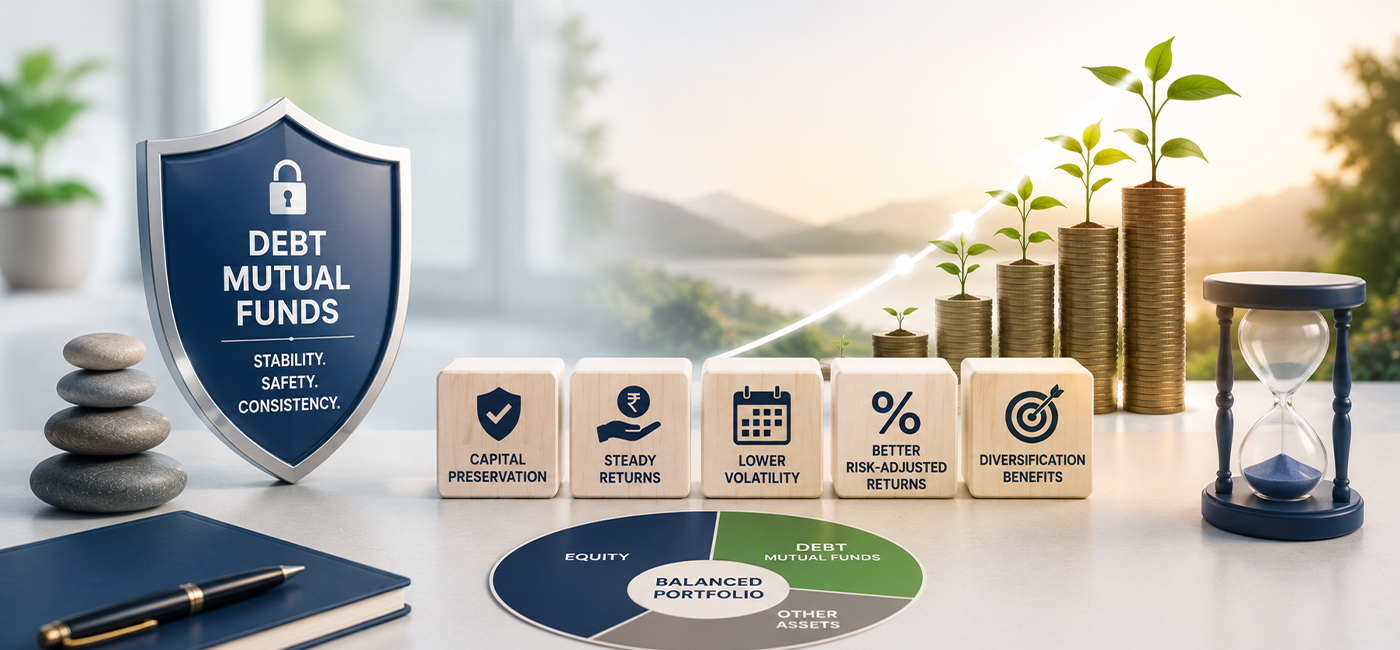
When most people hear the words “mutual funds,” they immediately think of the stock market. They think of high risk, daily price tracking, and wild volatility.
But there is a completely different side to mutual funds that has nothing to do with stocks: Debt Mutual Funds.
If you are keeping all your surplus cash in a regular savings account or fixed deposits, you are quietly letting inflation eat away at your purchasing power. Here is why debt funds are the missing anchor your portfolio needs.
Step 1 — Understand What They Actually Do
Unlike equity funds that buy shares of companies, debt funds lend money to corporate and government entities. They invest in government bonds, corporate debentures, and commercial paper. When you invest in a debt fund, you become the lender. The fund earns returns through fixed interest payments and changes in the market value of these bonds.
Step 2 — Pick the Right Type for Your Horizon
Debt funds are not a single product; they are a toolkit. You must match the fund type to your timeline:
– Overnight & Liquid Funds (Days to Weeks): Best for parking emergency cash or money you need next month.
– Ultra-Short & Low Duration Funds (3-12 months): Ideal for short-term goals like a wedding or an annual vacation.
– Short Duration & Corporate Bond Funds (1-3 years): Perfect for capital preservation over a slightly longer runway.
Step 3 — Capitalize on Superior Liquidity
Unlike a Fixed Deposit (FD), where breaking the deposit prematurely attracts a penalty or slashes your interest rate, most open-ended debt funds allow you to withdraw your money within 24 hours without penalty. This gives you the flexibility to move your money whenever a better opportunity arises, without sacrificing the returns you have already earned.
Step 4 — Manage the Risk Profiles
Debt funds are safer than equity, but they are not entirely risk-free. You need to look out for two primary risks:
– Credit Risk: The danger that the company borrowing your money defaults on its payments.
– Interest Rate Risk: The fluctuation of bond values when interest rates change.
Stick to banking, PSU, and corporate bond funds with high-quality credit ratings to keep your money safe.
Step 5 — Know the Modern Tax Structure
Following recent tax reforms, debt mutual funds are taxed quite simply: all gains are added to your total taxable income and taxed according to your applicable slab rate. While they no longer enjoy long-term indexation benefits, they remain incredibly efficient tools for compounding wealth over short-to-medium horizons compared to traditional bank options.
The Bottom Line
Equity grows your wealth, but debt protects it. Without debt funds, your portfolio is exposed to unnecessary volatility and lack of quick liquidity. Balance your money properly, and your financial plan becomes bulletproof.
At DRS Financial Services, we help you pick the exact debt mutual funds that match your short-term needs and safety profile—so your money works hard, even when it is resting.
Ready to add stability to your portfolio? Talk to DRS today.