The Perils of Churning — Why Trading Costs Are Draining Your Wealth
Investment planning in Rajkot
Investment planning in Rajkot
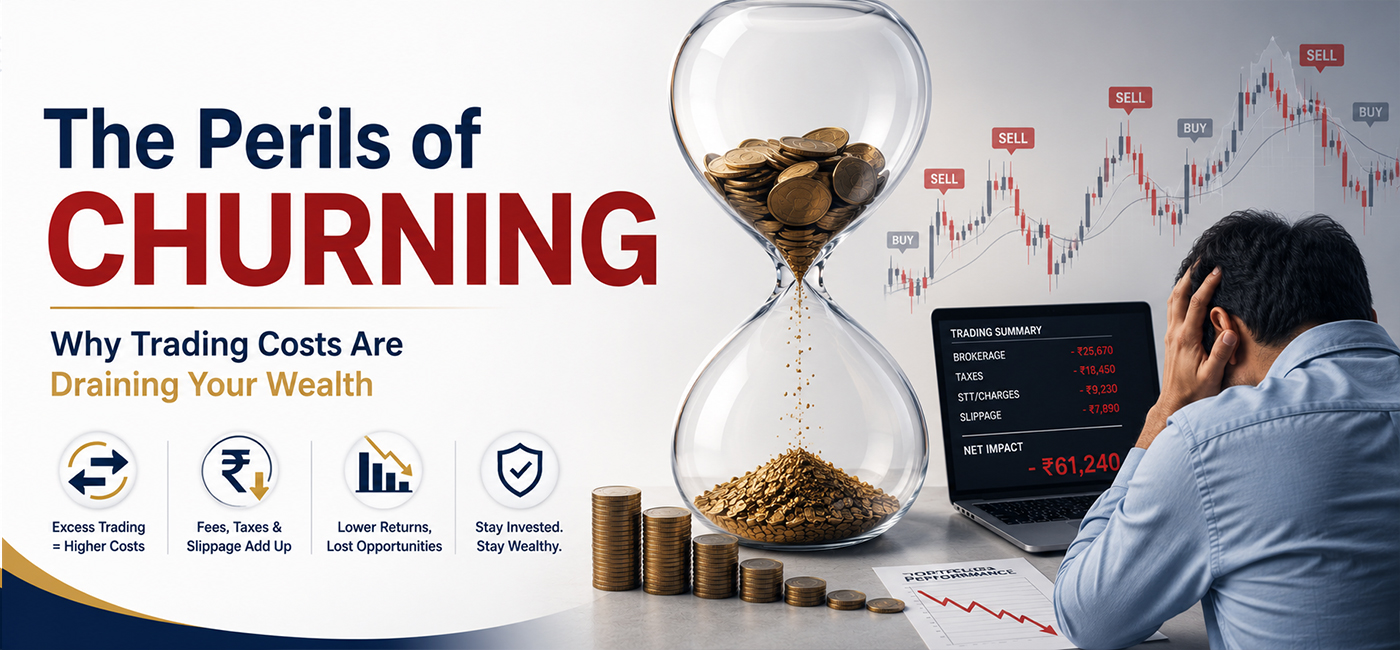
There is a widespread myth in personal finance that a successful investor must be hyperactive. People assume you need to buy a mutual fund today, sell it six months later because another fund topped the performance charts, and constantly hunt for the next hot asset trend.
In the investment world, high activity rarely equals high returns. In fact, it usually results in the exact opposite.
Constantly buying and selling units—a process called portfolio churning—creates a massive, hidden leak in your capital. Here are the five structural reasons why over-churning is quietly draining your long-term wealth.
Step 1 — Calculate the Impact of Short-Term Taxes
When you switch or sell your equity mutual fund units within 12 months of buying them, your profits are classified as Short-Term Capital Gains (STCG). Under modern tax guidelines, equity STCG is hit with a steep flat tax rate of 20%. By constantly shifting your money around within a year, you lose a full fifth of your profits straight to taxes, severely denting your compounding potential.
Step 2 — Account for Exit Loads and Transaction Fees
Many mutual funds charge an “Exit Load”—a penalty fee ranging from 1% to 2% of your entire asset value—if you redeem your money within a year of investment. When you add up exit loads, brokerage costs, and statutory transaction taxes, hyperactive shifting creates significant frictional costs that act as a heavy drag on your net returns over time.
Step 3 — Avoid the Trap of Rearview Mirror Investing
Why do most investors churn their portfolios? Because they look at a performance chart from the past 12 months, notice a different fund has done better, and move their cash. This is called chasing past performance. Mutual fund sectors move in distinct, rotating cycles. The fund that topped the charts last year is frequently entering a cooling period today, meaning churning often forces you to buy high and sell low.
Step 4 — Give Compounding the Runway It Needs
The true magic of compounding requires undisturbed time to build momentum. The early years of an investment look slow and modest, but as the asset base expands, the growth becomes exponential. If you constantly interrupt this process every 12 to 18 months by switching schemes, you permanently keep your capital in the slow, early stages of growth, never allowing the compounding engine to fully engage.
Step 5 — Rely on a Rigorous Annual Review Instead
Portfolio discipline does not mean blind stagnation. It means tracking performance based on a structured system rather than emotion. Audit your funds just once a year. Only consider making a structural change if a fund consistently underperforms its benchmark index and its immediate peer group for more than 4 straight quarters, or if its core investment philosophy undergoes a major change.
Investing is much more like planting an oak tree than painting a house. It requires deep patience, minimal interference, and long stretches of uninterrupted time. Stop chasing every short-term trend, eliminate unnecessary transactions, and let your wealth compound in peace.
At DRS Financial Services, we design long-term, low-churn investment plans, selecting highly resilient funds from day one so you never have to waste money on costly portfolio re-shuffling.
Want to audit your portfolio for hidden costs? Talk to DRS today.