The Cost of Comfort — Why Inflation Is Your Wealth’s Silent Killer
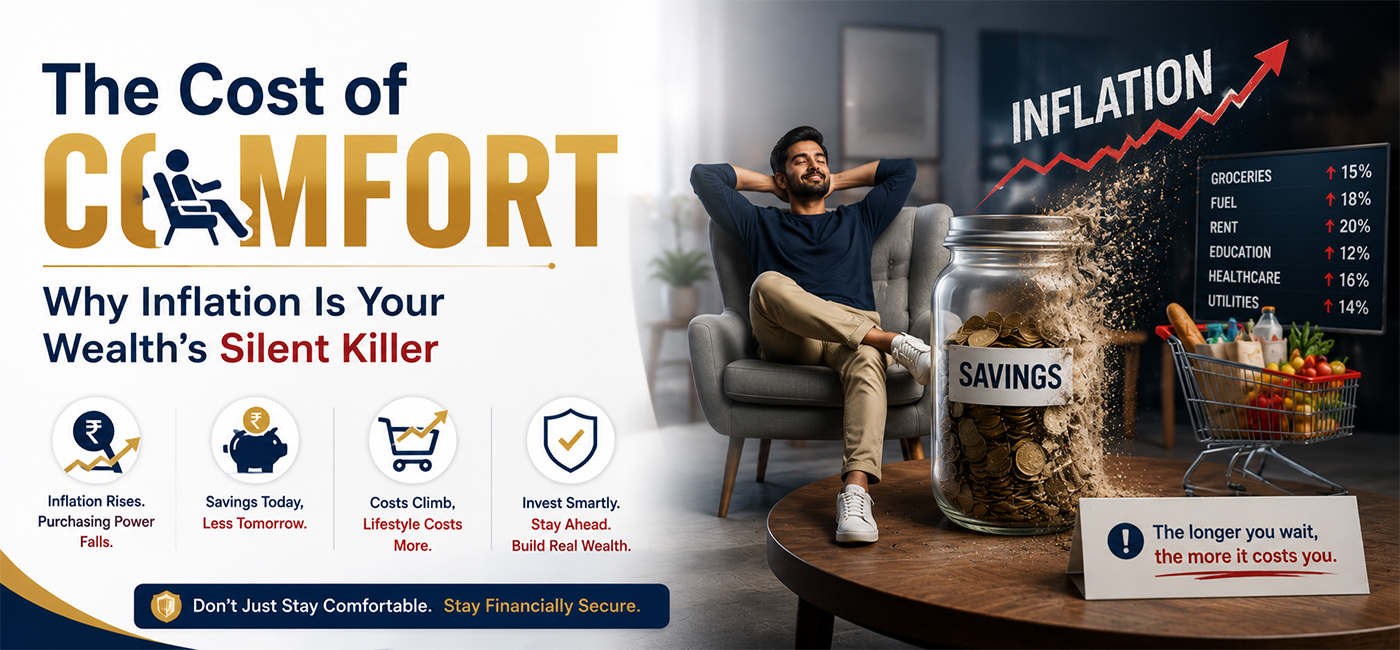
If you leave ₹10 Lakhs sitting safely inside a traditional bank savings account or a standard fixed deposit for 15 years, you will eventually check your balance and feel incredibly satisfied. Your statements will show that your money has grown securely, free from market drops.
This satisfaction is a dangerous optical illusion.
While the nominal number of notes in your account went up, the actual purchasing power of that money crashed dramatically. This is the devastating impact of inflation—the silent, invisible tax that erases wealth without you ever realizing it. Here is how to protect your hard work from it.
Step 1 — Expose the Invisible Force
Inflation is the steady, relentless increase in the price of goods and services over time. If inflation sits at a steady rate of 6% per year, the cost of everything you buy doubles roughly every 12 years. This means that keeping money in an asset class that earns less than the inflation rate isn’t safe at all—it is a guaranteed way to lose purchasing power every single day.
Step 2 — Track Lifestyle and Medical Realities
The official government inflation figures you read in the news are based on a standard basket of basic commodities. Your personal inflation rate—driven by lifestyle choices, high-quality private education for your children, and modern medical care—runs significantly higher, often hovering around 8-10% annually. If your investment returns aren’t clearly beating this personal threshold, your future wealth is shrinking.
Step 3 — Calculate the Real Rate of Return
To find out if your investments are actually growing your wealth, you must look at the Real Rate of Return. The formula is straightforward:
Real Rate of Return = Nominal Return Rate – Inflation Rate – Taxes
If a bank fixed deposit pays you a 6.5% interest return, but inflation sits at 6% and you pay a 30% tax rate on that interest income, your real rate of return drops into negative territory. You are effectively losing wealth by playing it safe.
Step 4 — Pivot Toward Growth-Oriented Assets
To defeat inflation, you must invest a meaningful portion of your capital into growth-oriented asset classes that historically beat the rising cost of living over time. Equity mutual funds, well-chosen real estate, and gold are classic examples. Because equities represent direct ownership in active businesses, companies can raise their prices to track inflation, allowing equity values to grow alongside the cost of living.
Step 5 — Match Assets to Your Timeline
You do not need to take extreme risks with all your money. Match your assets to your timeline: keep the cash you need over the next 24 months safe in highly liquid, low-risk options where preservation is the priority. But for any long-term goals extending past 5 or 10 years, ensure your money is deployed heavily into equity mutual funds so it can compound well ahead of the inflation curve.
True financial risk isn’t just about market volatility—it is also the risk of doing nothing and watching your savings melt away. To protect your family’s future, your money must grow faster than the cost of living.
At DRS Financial Services, we design custom, inflation-beating portfolios that focus on real, post-tax returns—ensuring your wealth actively expands in purchasing power over time.
Want to test if your portfolio is beating inflation? Talk to DRS today.